

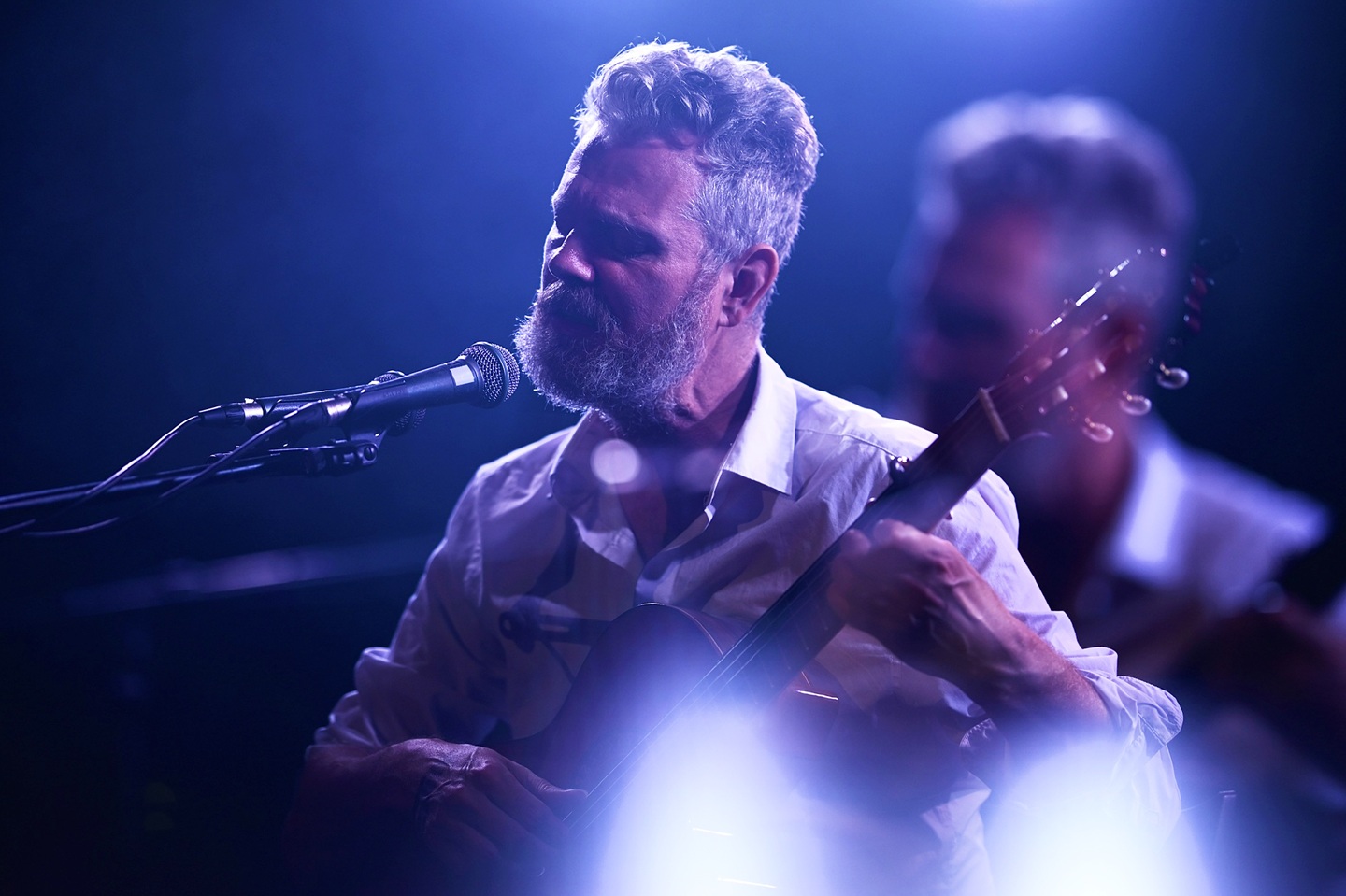
Matt Elliott, a Bristol singer-songwriter and one of the most prominent voices on the contemporary global folk scene: We have failed children massively. The biggest priority of most species of animals is to take care of the young and we, the most intelligent species, have failed monumentally. Art has the capacity to start conversations. What do you think about killing billionaires? Is it morally acceptable? All our lives are miserable because of billionaires, so this is an important discussion to have.
It’s otherwordly, that something, which spreads from the stage of Močvara through the darkness of the pleasantly filled club on Monday, May 18. The source is, seemingly, an entirely grey-haired musician who, hunched over, using a looper, guitar and saxophone, alone on stage, constructs monumental sonic landscapes, as fragile as they are colossal, as dark as they are moving, as intimate as they are universal. Only seemingly, however, because the solitary Briton, both through the rhythmic movement of his body and his ephemeral expression, sounds and looks as though something is speaking through him; as though before us there is not a musician, but a clairvoyant troubadour from another world.
Matt Elliott, the Bristol singer-songwriter most often genre-defined as an artist of dark folk, earned his reputation precisely thanks to the mystery that permeates his work. He first found success back in the 1990s with the electronic project The Third Eye Foundation, a time when he collaborated with world-renowned musicians such as Yann Tiersen, Mogwai, Amp, and Hood. His real breakthrough, however, came when, under his own name, he stepped into the more direct, instrumental waters of folk, and after twelve studio albums he is considered one of the most distinguished voices on the global contemporary folk scene. Through the content of his lyrics and his public statements, Elliott has also profiled himself as a vocal critic of the illnesses of the modern world, and in 2024 he even released a single aimed at raising funds to help Gaza. We therefore spoke with Elliott about his music, the reality we live in, and art’s capacity to change it.
It has been almost ten years since your last performance in Zagreb, and more than twenty since the album Drinking Songs (Elliott’s best-known album, author’s note). Even back then, your music and lyrics evoked a much older era, the turn of the century or the First World War. Is that merely a stylistic choice, or is there a deeper story behind it?
I wanted to make something timeless. With Drinking songs, Failing songs and Howling songs, I wanted them to sound like a recording that some guys in a bar had made on a gramophone, that someone later discovered. No one really knows anything about them, not even which country they came from, and they’re all singing about the human condition. It’s a mystery, so you imagine it. The Sinking Ship was a song that inspired the idea. One day I woke up and the melody just came into my head. Then I heard this drunken choir singing and the words came really quickly. It was like it was being beamed into my brain and I said “oh fuck, I need to write this down right now”. I got my friend to come along and we got really drunk, singing the song in the garage until about 4:00 in the morning. Once I recorded that, I knew what I wanted to do for the next album. I wanted to invoke a choir of sad men singing about life and death and sadness. It’s been nice to revisit a lot of my old songs with the saxophone. I’m working on a new album, so that’s where my main focus has been this last year and a half. These will be the last three shows with this set.
How do you see the relationship between the old and the new in music?
I listen to some modern music, but not very much. In most part, it’s old music, mostly jazz and stuff from the 70s and 60s, because you know it’s real music, you know it’s a moment captured in time. The YouTuber Adam Neely said that with AI, recorded music’s basically over. I tend to agree with them, because if you don’t have trust, if there’s always this question of “have they used AI?”, then you’re not listening to the music anymore; you’re having a conversation with yourself about the process. I also think that imperfection will make a big comeback. In the last 20 years, music production has gotten cleaner and cleaner, but that’s what AI does. It does that so perfectly, and I think people get really bored of perfection. That’s great for me, because I make lots of mistakes and I always complain about them when people talk to me. They say it was imperfectly perfect or perfect because it’s imperfect.
How else has the music landscape changed since you’ve started?
The internet’s changed things a lot. I’m really lucky I have people every day from all over the world write to me in places I never even heard of to tell me how much my music means to them. That’s something that can only happen with the internet. I was really lucky with Drinking songs, the YouTube algorithm just said “this is good, I recommend it” and it was a self-feeding beast. That was the single biggest promotion I ever had and it was a complete accident. No one did it, it was just pure fucking luck, lottery. In the old days you had to pay press companies to get you an interview and reviews. Now you don’t even need reviews.
Streaming has also changed things a lot. I’m not against streaming. I’m against the way that it’s done – I’m against Spotify. This prick from Spotify (Daniel Ek, author’s note) steals our music, sells it for a tiny price, keeps as much as he can, and invests it in artificial intelligence weaponry. It’s fucking crazy! I would take all my music off Spotify but for some people in the world, like in Iraq, it’s literally the only way that they have access to my music, so it’s an ongoing struggle. When the old record label was trying to convince me to put my music on Spotify, I said “I don’t like it, I’m boycotting it” and they said “well who the fuck are you? You’re nothing” – which is nice to hear from your record label. But it’s true, I won’t make a difference. There needs to be a mass movement of very popular artists to make a difference. I would urge people to use other streaming services.
The way music is “consumed” today mirrors the aesthetics of modern popular culture, that is to say hyper-acceleration. On the opposite side of the spectrum, there’s your work which seemingly slows down time. It invites you to take in the moment and meditate upon it, opens up space for introspection. Is there a philosophy behind this?
I’ve never really been into the pop song thing, much to the chagrin of some of my record labels, because they always need a song for the radio, 4 minutes maximum. For me, a song takes as long as it takes. I like the classical or jazz idea, you go on a journey. It’s true that music is accelerating, like Mason or Jacob Collier, it’s all very quick stuff. For me, that doesn’t really… All music has at least one of three elements in it: an intellectual element, a technical element and an emotional element. The only element that’s important for me is the emotional element.
This certainly reads through your lyrics. Often even when your songs are overtly political, their starting point is intimate. Why do you intertwine the personal and political in this way?
I always try to be honest and frank, I also like to try and write songs that could have been written at any point in time, and I try to keep things a little bit open to interpretation as well. The End of Days starts off inviting someone to just go for a walk and have a conversation. “You asked me why I’m feeling sad and this is why, because the future is fucked.” Bomb the stock exchange is a very dark joke: if you want to kill yourself, why not do the world a favor. The new set I’m doing is mostly political songs because I think now is the most important moment to be political. One of the duties of an artist is to talk about injustice. The new album is called This World Is No Place for Children.
So continuing the optimistic tone of your last “End of Days” album.
It’s a real statement because honestly, we’ve failed as a society. There shouldn’t be at this point in human development with everything we have at our disposal – the resources, the knowledge, the science – there can’t be a single child starving in the world. There certainly shouldn’t be armless children scrabbling around in rubble after being bombed out. The president of the richest country in the world shouldn’t be someone who fucks children. We’ve failed children massively. The biggest priority of most species of animals is to take care of the young and we, the most intelligent species, have failed monumentally. I feel bad when I see someone pregnant.
You even say so on The End of Days in one of the most chilling verses: “And even all the smiles on children’s faces bring you pain, When you think of what they’ll face, And if they’ll even come of age, A world resigned to flame”.
Exactly. So this is a sequel to that statement. That song is, of course, more about the climate disaster, which is going to unfold in the coming years and has already started unfolding. Water resources, waste as well. The smiles make me sad because I wonder what kind of world these kids are going to grow up in and are they gonna be at some point literally fighting over the bodies of pigeons because there’s no food. It can happen in our lifetime. I’ll be alright, I’m in my 50s now. But I fear for you when you get to my age. We’re beyond fucked. We’re in a ship, and it’s heading towards the cliff, and you have to turn the ship around and you just can’t. Time is running out, the window is closing.

Does art have the capacity to change the course?
I do think that it has the capacity to start conversations. There’s two [political] songs on the new album. One I normally introduce after I’ve done a couple of sad songs. I say “now to lighten the mood, here’s a song about killing billionaires”. It’s not because I generally want to see a billionaire killed or anything, I wouldn’t ever kill a billionaire. I couldn’t kill someone, though I won’t weep if a billionaire dies. Twenty years ago I wrote a song about killing billionaires called Planting seeds and that’s the idea; planting seeds to start the discussion. What do you think about killing billionaires? Is it morally acceptable? You can’t be a billionaire without having blood on your hands, it’s fucking impossible. All our lives are miserable because of billionaires, so this is an important discussion to have. The place of art is to show extremes and to show fantasy, and we’re allowed to fantasize.
Then there’s a song about Gaza and that is probably the most specific song about a thing that’s happened. It’s such a traumatic experience for everyone who’s witnessed it, who’s got a soul at least. It’s marked me forever, I’ll never be the same again, nor should any of us. It’s been absolutely barbaric, and it’s not just the death and the destruction, it’s the cruelty behind it. It’s the the dancing around in the lingerie of women whose houses had been trashed, it’s playing games sniping children. I’m sitting at home just like anyone else and it’s happening in front of me and there’s nothing I can do. You can’t save these kids, you can’t explain to the guys not to do this. It’s a hopeless mess, and the hopelessness is traumatic, it’s a collective trauma. And I don’t know where it’s gonna end. Everything that’s happening now, it’s a result of fucking American imperialism.
The Gaza genocide has not been without reaction and an anticapitalist or anti-imperialist stance is becoming more mainstream. Do you think the tides are changing?
It’s interesting that what’s happening is deeply unpopular. No one likes seeing dead kids, but the mainstream media is just treating it like it’s a war. This whole crackdown in Germany, you can’t even have a watermelon symbol anymore, that’s considered a hate crime. It’s fucking crazy, and people don’t like being told what to do. When I wrote Planting seeds, people were saying it’s extreme, now everyone says good point. When Luigi Mangione did his thing, like everyone I was surprised by his courage, but I was more surprised at the reaction to it. The way they wanted to report it was a mad man on the street killed a CEO, but the reaction they got was everyone unanimously saying this guy’s amazing, and it helped he is handsome too.
When I grew up with capitalism, capitalism was our friend. You know, it gave us cool stuff. Now, it doesn’t give us anything. You work three jobs and you just pay your rent and you don’t have anything extra on top of it. And I think the young people now just say “fuck it, I don’t want to do that anymore”. There is radicalization, unfortunately it goes in two different directions. That’s a terrifying thing as well, especially if you’ve studied world history.
But you still have hope?
I know I sound miserable, but I have hope in young people. It’s the only thing that gives me any hope whatsoever, because they do tend to be a bit more switched on. People say “no, the young people on their phone”. Yeah, sure, of course they are, I’m on my phone all day as well. But in general, they’re engaged. They understand. And they react in different ways. Depression amongst children is very high, but then so is engagement. A lot of kids are speaking up and doing these walkouts, they’ve decided that this kind of gig economy is not for them. They don’t allow people to treat them like shit. What I wish would happen was young people would organize and clump together to say “we’re not going to wait around”.
One thing the left love to do is in-fighting, factions fighting against each other. At the moment boomers are still in charge. If you wait for us Gen X to hand you the world, you’re gonna have a bowl of fucking dust. So I wish you would all collectively organize, especially because now we have that power. We have the internet, we can do mass communication. You can be organising with youngsters in China, organizing general strikes. We’ve never had that before.
