

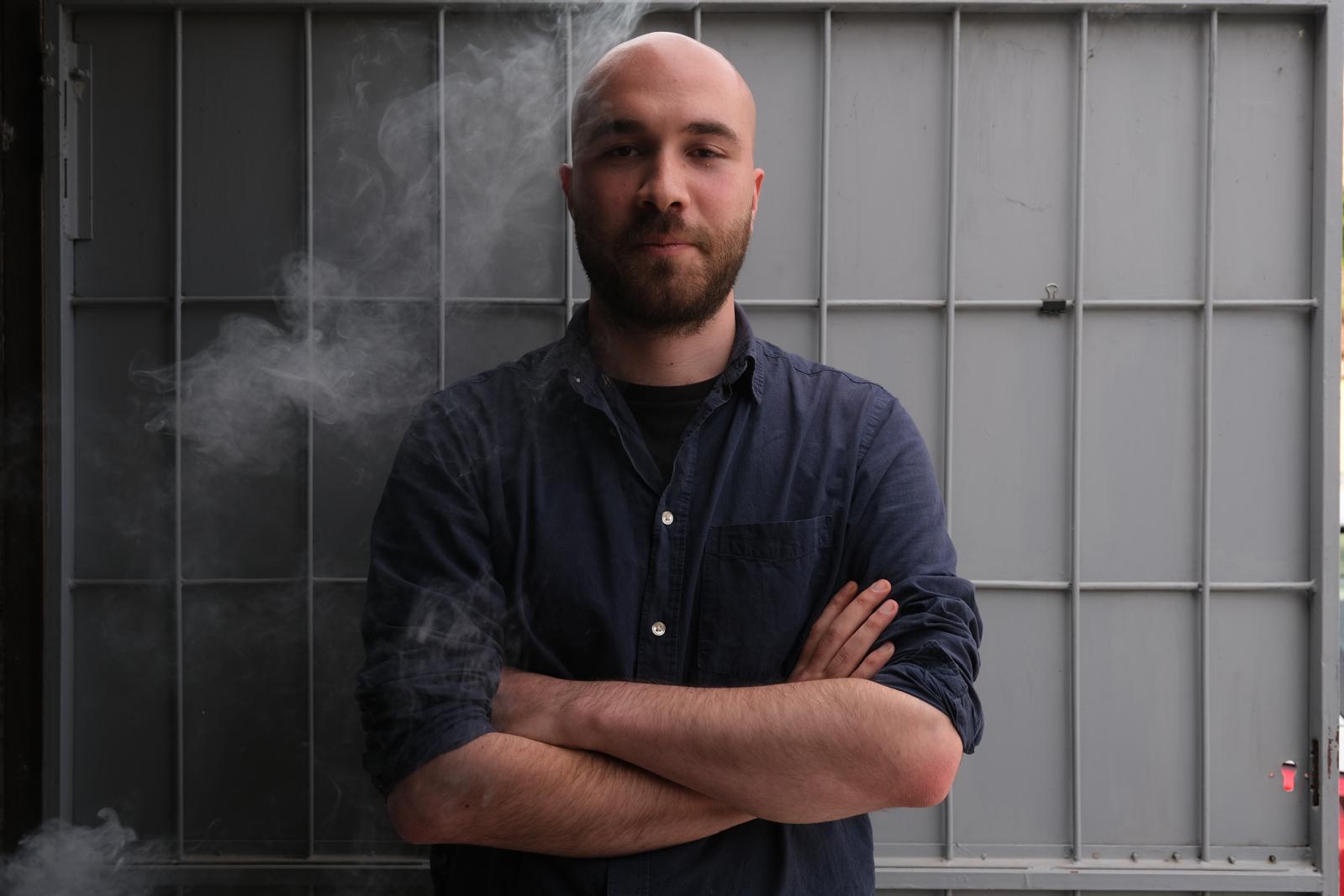
Young Turkish artist Mithat Can Demir, the author of the exhibition “How to Protest”: If you are united and persistent, you can break any power. It does not necessarily have to be the president of Turkey—you can break whoever you want.
In a country where protest is synonymous with a walk before lunch or a night out, an exhibition titled How to Protest? reflexively raises eyebrows. All the more so as its announcement situates the work within a somewhat more radical tradition of resistance, introducing an accompanying workshop on making DIY gas masks and evoking the kind of urban warfare characteristic of more militant protest environments. Mithat Can Demir, a young artist for whom this was his first solo exhibition, brings the seeds of a more radical form of resistance from Türkiye – where he moved from three years ago – into one of the focal points of the independent visual arts scene, Garaža Kamba.
The Istanbul-born artist recently graduated in new media from the Academy of Fine Arts in Zagreb, and previously studied arts and cultural management in his hometown, also completing a professional internship with WHW in Zagreb. His readymade for protesters was, in accordance with Kamba’s operating principle, on view only on the 8th of May, although the same work is scheduled to be presented in September, organized by the Domino association. To answer the question How to Protest, one should visit the exhibition – but we spoke with the artist about the political situation in Türkiye, the relationship between art and resistance, and contemporary possibilities for protest.
What’s the story behind the work, how was it developed? How did it find its way to Kamba? Can you quickly describe it?
Last year protest started to happen after the arrest of the mayor of Istanbul Ekrem İmamoğlu. In one night they revoked his diploma and the morning after they arrested him, and soon everyone from the opposition party that offered to come to the mayor’s side. I wasn’t there but I was following the news and I was seeing young people getting tricked by police, easily arrested in small groups, getting beaten. People were doing weird stuff, nonsense, like push-ups in front of the police. I was in a bad mood and wanted to do something, when I’m like that I look for social issues… probably as a coping mechanism or something.
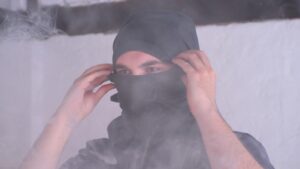
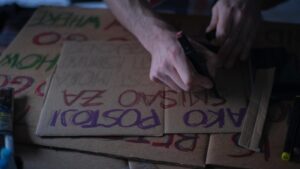
It’s called How To Protest because in these recent demonstrations the young people were not very organized, not very educated in terms of protesting. There was no initiative or institution to organize them and I thought I could write a guide book. So I started by writing a story for the end of the semester exhibition, about a character that’s going to a protest. Maybe I could teach people to make something, like a gas mask out of a water bottle and mask out of a t-shirt. I shot some videos at the academy and put the objects I mentioned next to the video so it all became an installation.
A lot of readers might not be informed about the situation in Türkiye. Can you give us a quick introduction to what preceded the arrest?
It’s a long story, more than 20 years. A group of people that worked with the president (Demir leaves out the politician’s name out of caution, op.a.) tried to take over the country with a military coup in 2016 (the president called this a gift from God op. a.). They failed and right after that the president held a referendum to change the constitution, which passed with 51% of the vote in 2017. Leading up to the referendum they were spreading fear, convincing the people that if they’re not powerful bombing attacks will happen again. Before, we had a president and prime minister, and suddenly the regime in Türkiye became more like USA where the president has a lot of power. There were also claims of rigged elections.
Life is bad now. The education is getting worse, the economy doesn’t exist. It’s not hyperinflation, but the price of everything goes up monthly or even weekly. Three years ago, one euro was equal to 16 Turkish lira, and now it’s more than 50. Due to this, now it’s all about the hate that the government is spreading. For example, there were a lot of stray dogs in Türkiye and now they’re having internet bots spreading hate towards dogs. They divide the Turkish people on subjects like this, so the people don’t unite against them. Everyone hates everyone.
During this new wave of protest, there was a lot of division between the protesters. Kurds and LGBTIQ+ people were not being accepted into the movement, which wasn’t the case before. What you’re describing sounds like the same strategy.
That’s the only point actually. If you’re not together against something, then you’re not as powerful. For years that’s been their main plan – divide people. I was hearing that they were using civilian police in demonstrations that would be pushing the protesters to the police for them to get arrested. They have a lot of good ideas to divide and break us. That was the main purpose behind arresting İmamoğlu, because he was some sort of a rock star. He won four different elections against the the president’s party, it was almost certain that he’s going to be president if he goes to the next election.
Are the protests still going?
The leader of the opposition party is talking and going around the whole country, making his own rallies. But it’s not like there is some sort of an emergency where everyone’s protesting or boycotting. It’s gone. I was involved in Boğaziçi University protests which are still sort of happening. The president now has the power to choose university rectors and he changed the one in Boğaziçi, which is why this started. It was not very violent or crazy but the professors are still going out in front of the university building to stand in silent protest as far as I know.
It’s interesting to draw parallels between the Gezi protests that happened in 2013., especially since they had a very artistic edge to them. How are the new protests different?
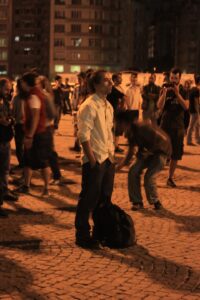
The Gezi Park protests were held in Taksim Square (a square dubbed the heart of Istanbul with strong symbolic and political connotations op. a.) and after that, the president ordered the police not to let anyone demonstrate there anymore. It’s their main fortress to defend. The artistic part of Gezi Park happened because people actually managed to be in Taksim, they were literally living in there. They were doing their activities, some turned into art. Erdem Gündüz stood in front of Atatürk Cultural Center which went viral, he became The Standing Man. People were expressing themselves more easily in Gezi, a lot of artistic groups were established there. Now there was no place to do something like that. People were telling the politicians holding the rallies to go to Taksim but they wouldn’t. They were in other places giving a speech, playing a song and then telling people to leave. The people who wouldn’t leave were getting the force of the police.
Your work walks a fine line between actual protest education and art, which is in itself reminiscent of Gezi. How do you see the relationship between art and resistance?
I was writing a thesis about a small book called Disobedient Objects (Gavin Grindon, 2014, op. a). These are the
public objects that change use and definition, e.g. trash cans that get used as
Source: Wikipedia
barricades on the streets. If you’re changing something, creating a new definition, you have a metaphor and I think that’s called art. You have to change the definition of lots of things in a protest; if you’re just a simple person you need to be creative to resist and you need to create a lot of stuff. If you’re creating a lot of stuff, then you’re also creating some sort of art. It’s a way of seeing the objects around you.
This is what I was seeing in Gezi Park. The people were living there, creating their own art in that place together. They were making classes, workshops etc. Resistance creates art on its own when it has time, like The Standing Man. He was just one guy who was standing there and a lot of people started to join him – it became performance art. I’m not saying resistance is art or it’s all about art, but art is something that is created naturally during resistance.
Since you’re exhibiting a work inspired by Turkish protests here, one has to ask if you’re trying to connect local events to the ones in Türkiye. Can you compare the situation?
I don’t think there is as much police brutality here, the police in Türkiye has no limits anymore. They have all the powers, they just go next to you and start pepper spraying you.
I think that it’s not that tough here, and that people can get more organized, have more impact. I think there’s room for it, but I don’t know if there is any room for Turkish protesters to be able to do it anymore. But I didn’t do it for only Turkish or Croatian people, I did it as an international guide book. This work gives some instructions to some people so they can apply it themselves.
Speaking of comparisons, you’ve been involved with both the Turkish art scene and the Croatian one. How do they differ?
The reason I wanted to move to Croatia is because I studied Arts and cultural management and was able to see some of the people from the art scene of Türkiye. The scene is very privatized, owned by the rich. If you don’t have a wealthy background, you’re not able to get into those corners. Lately those big names were changing their rotations to more AI arts. They write “art is wild” on the wall with LED and exhibit it. I was not impressed so I wanted to move here when I saw exhibitions here. When I came I realized everyone in the art scene knows everyone. I literally know everyone in the new wave art scene, I was feeling like I’m part of it from the start. This is not the case in Türkiye. In Istanbul you need to be the son or daughter of a very important person, go to private schools and to America for private internships. If you’re not coming from a certain class, you cannot be in the network of those people, so you cannot work in the art scene.
Is this connected to how art is being funded? You said it’s mostly private.
Banks are very active in the art field. I don’t remember that many public galleries in Istanbul. There are lots of independent artists, but it’s also a corner that you cannot get into anymore. The independent artists have their own space, but over time they also became private in their own way. Everything is a corner you’re not able to go into if you don’t know anyone.
Up until relatively recently, the history of art has always been connected to power and money. The aesthetic objects we see as canonic are usually from the ruling class. Your work on the other hand gives aesthetic importance to the bottom up approach, disobedient object as you say. Do you see art going in a more democratic direction like this?
The aesthetics of the arts have changed a lot. There is no need of an aesthetic means when you look at something anymore. Of course, you can still do something that’s aesthetic, it calms you, but I don’t feel this is necessary to create art. I think the only important thing in art is the meaning, the metaphor you create behind the object. Even this lighter here, if there’s a good story behind it, it can be a good art piece. Just a lighter on its own. Anything you do can be art, therefore everyone can do art. I don’t say something is good or bad art. If you can create an idea, it’s a good idea, though I can say I don’t feel it is for me.
The story behind your piece is a fictitious scenario with a person named Deniz, involved in an urban civil war defending a part of the city. How is this strategy viable for actual political change to manifest?
Taksim was the historic part for protesting actually, so if there’s a lot of people protesting there, it also has a historic meaning to it. One of the struggles I was talking about is everyone hates each other, you need to break this in order to unite and march through the barricades into Taksim. If you reach there, if you reach the top, you can make an impact. You can start boycotting, there’s a list of companies to boycott that are connected to the president. If you boycott, it means there will be an economical struggle in the country. If you create an economical struggle, the rich people will get affected. If rich people get affected, then they will not be happy with the president. If you do this, if you’re united and persistent, you can break any power. It doesn’t necessarily have to be the Turkish president, it can be Trump or Lukašenko. You can break anyone you want. I think this is the successful way to do it, but I never saw a successful protest in Türkiye.
Yet you still have faith in it?
It’s not acceptable to be hopeless. If you’re a protester, if you classify yourself as a revolutionary, you cannot be hopeless. As long as you breathe, there’s hope. This work is a source to be added to someone’s library in case of need. This isn’t something big, I was never after doing something big. You cannot change a lot by yourself, it should be done brick by brick. This work is a brick to put on your wall.
