

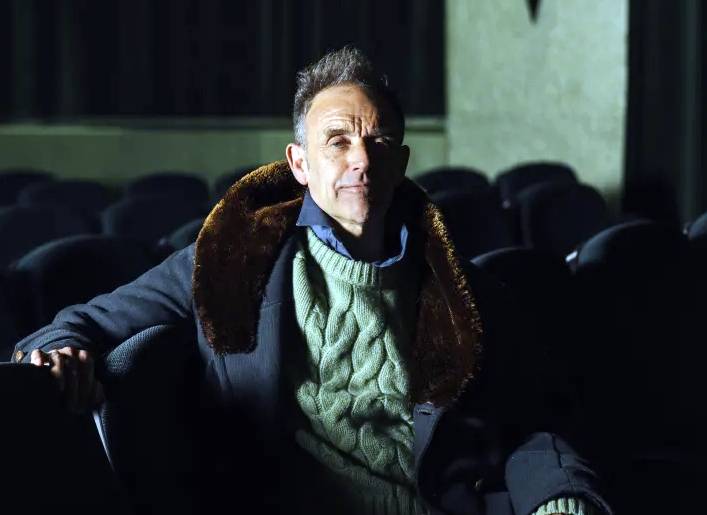
Johan Grimonprez, Belgian filmmaker: UN is still a colonial institution, which was quite obvious when it came to the vote about Gaza. And so the veto that the United States put forward is a symptom of the fact that the situation hasn’t changed. neo-colonial situation is still set up at the cost of women in East Congo. And Europe is complicit.
Not so long ago, the publisher of this portal organized a design competition for a poster marking the centenary of the birth of Patrice Lumumba, the first legally elected prime minister of the newly decolonized Democratic Republic of the Congo. Few people today remember that Sesvete once had a street named after this statesman, who, only a few months after assuming the office of prime minister, fell victim to a conspiracy involving U.S. intelligence services, mining companies, and the former Belgian colonial authorities.
The film Soundtrack to a Coup d’État addresses the tragic events of 1960 and 1961, but also much more. Brilliantly directed and edited, this two-and-a-half-hour documentary truly, just as its title suggests, creates an impression of an intricate interweaving of sound and image, music and politics.
In the late 1950s, the administration of President Eisenhower sent its “ambassadors” around the world: jazz musicians meant to impress audiences globally, who in reality became fronts for CIA covert operations, mostly in regions formerly known as the Third World. However, polishing the image of a racially segregated country was far from easy, and for the mostly Black musicians this role increasingly became repellent.
By the time of Lumumba’s downfall in early 1961, even the musicians had become aware of the dirty and duplicitous game being played by the U.S. administration.
Many residents of Zagreb have since gone to see Soundtrack, ever since the film’s screening at the Subversive Film Festival, and its author, Belgian director Johan Grimonprez, returned to Zagreb as a guest of a program at Dokukino KIC. Interestingly, we sit and talk with the director just a few minutes’ walk from the spot where the American jazz musician Dizzy Gillespie gave a concert in Zagreb in 1956, as part of one of the tours devised to win the hearts of audiences in the Third World and in countries of real socialism through American popular culture.
The year has started quite symptomatically in terms of American neocolonialism. What is your view on all of this? Will this year be a turning point, as some are predicting?
Well, I think the turning point was around 30 years ago.
In what way?
Well, you know, I don’t think it’s just the United States. It’s also NATO. And NATO basically, you can replace the word with Lockheed.
NATO pretends to be a treaty organization that includes Europe, but basically it’s just sending Lockheed material. Every European country that’s part of NATO has to buy the F-35. So basically they’re sponsoring a corporatocracy, which is not necessarily only a US thing. Corporatocracy in this sense is actually a global conglomerate, because they’re multinationals. And this is a big problem, because there’s no institution that can hold those multinationals accountable. They even make treaties that actually allow them to sue countries. They can hold countries liable. And so this is sort of an upside-down world, basically.
You know, I don’t think it’s Trump or Biden or any administration. Of course, Trump is a far-advanced symptom, but it’s a symptom of something that is much deeper and systematic.
In Shadow World there’s an analysis of how corporations, through the lobby system and the revolving door, actually have a hold over the government. And the corporations are multinational. So it’s the same for the European Parliament. There are more lobbyists than politicians. There are three defense lobbyists for every politician in Washington. So I think that’s the problem. And Trump is just driving on that bubble. It’s a symptom of something that’s much deeper for me.
And we just analyzed this in Blue Orchids and Shadow World, and in another way in Soundtrack to a Coup d’Etat, where the mining industry is the problem.
Can you please expand on that?
Katanga was the private property of Leopold II and of the conglomerate Union Minière, which had holdings also through the United Kingdom and the United States.
William Burden, who was the president of MoMA, who was an adviser to the Pentagon, CEO of Lockheed as well, and then became the US ambassador to Brussels, was actually a secret CIA spy.
Same with Foster Dulles. Foster Dulles was the Secretary of State in the United States. He was a lawyer for a company that had stakes in Union Minière. The deputy Secretary of Defense at the time also had stakes in it. So again, it’s not just that Belgium was involved in the assassination and the overthrow of Patrice Lumumba, the first democratically elected leader in Congo. It was also a global conglomerate that actually had its tentacles across the Atlantic.
And I think at the time President Eisenhower was afraid that NATO would crumble, and it was sort of contextualized by East and West. How the world was divided actually made him choose to sustain the colonial countries.
And if we talk about post-colonialism, I think it’s a bad misnomer. I would call it neo-colonial, because you mentioned the word neo-colonial. I think in 1960 that was ground zero for how the West was about to deal with the independence of all these countries. It was a neo-colonial grab. And I think the assassination of Patrice Lumumba was the ground zero. And I think basically it has only exacerbated since then.
So the turning point was much earlier. I think if we don’t change the paradigm from profit to the paradigm of the social fabric, we’re not going to solve this. I think that’s really what’s ultimately at stake.
The UN is an important theme of the last film. Is this body completely devalued today?
The 15th General Assembly was quite remarkable, because not only was the decolonization resolution proposed and then ratified on the 14th of December 1960, but also 16 African countries were admitted, among them the Congo. That caused a global shift, because the Global South gained a majority. But even later in the film we have Kwame Nkrumah proposing that Africa should have a seat on the Security Council. Africa still doesn’t have a seat on the Security Council. So it’s still a colonial institution, which was quite obvious when it came to the vote about Gaza. And so the veto that the United States put forward is a symptom of the fact that the situation hasn’t changed, basically.
Even if young representatives come in with a lot of hope to change the world, they’re always smothered by the directives of the specific countries, which is still all about control. I think there, as well, there is still an authoritative stance of centralized government that doesn’t speak in dialogue with what’s really happening politically.
I think a sense of dialogue is missing. I think it doesn’t have to come only from above. It can also come from both above and below. And I think there has to be a dialogue between those two moments.
Media manipulation is a frequent topic in your work. What is your view on the current state of consensus-building? Do you think it’s worse than during the Cold War?
I think there is an ontological shift. Instead of talking about media manipulation, you have to talk about how reality itself is being tampered with. During the Bush Jr. administration it was Karl Rove, Deputy Chief of Staff, who uttered that basically they own reality. “We actually make reality,” according to how society shifts. It’s not media manipulation anymore. It’s reality that’s at stake. Media used to have to catch up with reality, but now reality has to catch up with media. And I think that’s an ontological shift.
When did the shift occur?
Well, 9/11 was a big example of this. Slavoj Žižek talks about how, within the political unconscious, it was as if Hollywood was running ahead of reality. What we saw on 9/11 was something already living in the political unconscious of mainstream media that came to haunt the United States as reality. That’s how Slavoj Žižek defines it.
For example, in Syria in 2014 it was put on the agenda to get rid of Assad, the leader of Syria, and ISIS was invented. Reality was invented and sponsored.
Bandar bin Sultan Al Saud, who at the time was called Bandar Bush, helped create ISIS in Syria. And so this created a proxy war, which creates reality that then actually affects decisions, like the fact that the United States is going to send missiles or drones. So it’s not media manipulation. It’s actually how reality has become a reality tunnel, and how reality has been played with, in a sense. And Karl Rove was very open about it: “We own reality.” That’s how he said it. It’s much more perverse than media manipulation.
Journalism now is basically a mouthpiece for a corporate media conglomerate, and if you do real investigative journalism, you are called a criminal, like Julian Assange. Real journalism has been criminalized. Media is inherently a big part of creating reality.
Who are today’s “useful idiots” for the imperialist projects of big countries?
Well, let me correct that.
In the movie we can see Abbey Lincoln together with Rosa Guy and the Women’s Rights Coalition in Harlem crashing the UN Security-Council. I don’t think they’re useful idiots. They’re actually confronting the useful idiots, who are the US representatives to the United Nations.
Of course, some were used as jazz ambassadors, but it was very schizophrenic, because most of them were second-rate citizens in the United States. Most of them were not passive agents.
Even if Louis Armstrong is sitting in front of Larry Devlin in Katanga in East Congo, and it’s Devlin who is plotting that same evening and paying Mobutu, who is plotting the assassination of Patrice Lumumba. Armstrong is being used, but he’s still grilling Moïse Tshombe, the then president of Katanga, a puppet of Union Minière. Armstrong is confronting him, saying, “You’re in bed with big money.” He is being used as a propaganda tool, but he still speaks out.
“Useful idiots” today may also be part of the music industry, which is part of how we’ve been turned into consumers instead of citizens. I think the entertainment industry has, in a sense, sold out.
Belgium and the areas that were part of the former socialist Yugoslavia, as founders of the Non-Aligned Movement, have significantly different experiences of the Cold War. How is the Cold War period and the nation’s participation in the first years of Congo’s independence viewed today in Belgium?
Articulation in Belgium is very limited, but there is an influx of Afro-Europeans who add to the neo-colonial debate, I would say. And so there is a change underway. But you have to know that only two years ago the tooth of Lumumba was repatriated, and Juliana Lumumba, the daughter of Patrice Lumumba, was invited to the Royal Palace. So this is very recent.
When Ludo De Witte published his book in 1999 about the assassination of Patrice Lumumba, there was a parliamentary commission, but it was still weak.
The film ends by stating that the Belgian government was complicit in the assassination. That is still not fully admitted. They still try to hush it up. When the royal couple went to Congo two years ago, there was a discussion about whether they should say they were sorry or that they regret it. If you say “I’m sorry,” you admit to a crime and have to talk about reparations. If you say “we regret,” there’s no follow-up.
There are still things you can’t talk about. For example, the genocide of 1964 is still being celebrated by some para commandos as the liberation of whites in Kisangani, formerly Stanleyville. But the genocide itself is still swept under the carpet.
There is a sort of bubble, you know, just as there is around every important world event.
I would even say that about the whole articulation around Ukraine. I think there’s a lot of misinformation there as well.
In what way?
Not many people remember that Gorbachev literally had the West agree to a stop to NATO expansion when he withdrew troops from the Eastern Bloc countries. It’s never talked about. Negotiating peace with Putin could have happened much earlier, but the continuation of the war was willfully provoked as a way of, again, selling arms.
Zelensky gets 40 billion US tax dollars, and maybe 20 billion goes back into US corporations to buy arms, and maybe something ends up in Monte Carlo. Those 100 million corruption that is recently talked about within the Zelensky government, I think, are a very small figure if you’re talking about 40 billion.
I’m not saying this because I’m advocating for the war or because I’m a Putin apologist. You can still criticize and be critical of how the West is pushing a certain agenda. Very often, someone is labeled a conspiracy theorist to wipe the truth off the table.
Did you take the film Soundtrack to a Coup d’Etat to African countries? If so, how did the audience react?
Basically, there aren’t a lot of cinemas there, but the film has been pirated in Congo, which I really think is a compliment. The film has been distributed in Nairobi. The granddaughter of Lumumba wants to show it now in Kinshasa. There’s a huge Congolese community in Brussels, in Matonge, where the film premiered.
Friends of the Congo also organized a screening in Harlem at the Maysles Center. I had a long conversation with Kambale Musavuli in Harlem with Friends of the Congo, where he was the spokesperson.
I’m very outspoken about what’s going on in East Congo, because there are ten women raped every minute in Congo today, which is a direct result of what was installed and what was shown in the film. Friends of the Congo are very much trying to bring this into the open and talk about it. There are statistics at the end of the film. If you put a map over East Congo, there’s a direct correlation between mining sites and the statistics of raped women. These things haven’t stopped.
M23, the private militia organization, precisely responsible for these rapes, is also sustained by Kagame, the leader of Rwanda, and the European Parliament holds its hand over his head because they’re still sending weapons as well. He’s called the man who solved Rwanda, but that’s a joke, because he’s actually emptying East Congo and sending resources to China, or even gold that goes to Saudi Arabia through Rwanda, even though Rwanda doesn’t have any gold.
So that neo-colonial situation is still set up at the cost of women in East Congo. And Europe is complicit. I’ve been in dialogue with Maliyamungu Muhande. She published an article in The Nation on “complicit silence.” She said, “Well, everybody watches Soundtrack, but then what? What’s the follow-up?”
Her uncle was also killed recently by M23 in East Congo, and she’s very much an advocate around this issue. When we went to the Oscars, we had prepared a speech about the raped women in East Congo.
No Other Land won, and still nothing changed in the West Bank or Gaza. All this recognition ends up like a Band-Aid on a wound. The people from the movie are still dying in Palestine.
