

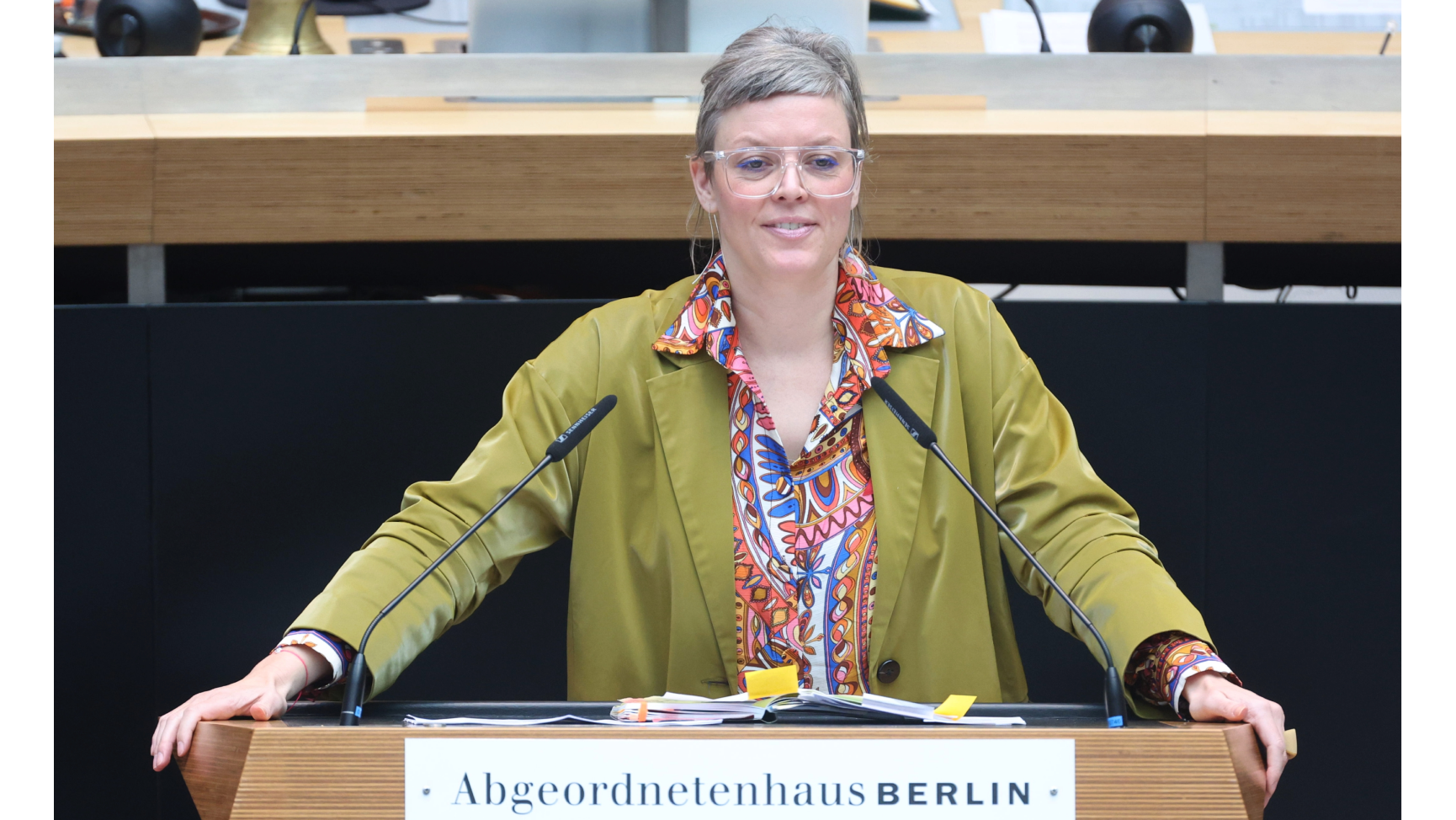
Katalin Gennburg, member of the German Bundestag representing the Socialist party The Left (Die Linke): In terms of housing, the first step is easily achievable: cutting rents and reregulating the housing market so as to push speculation out of our cities. The conversation about urban development has to be linked to the question of democracy. The best way to achieve that is by means of establishing public supervision over land ownership. Cities cannot be investors’ laboratories; we need radical democracy in spatial planning.
During the last weekend of July, the Croatian Association of Architects hosted the conference Housing without Borders: from EU policies to local practices, bringing together domestic and international experts in collaboration with Pravo na grad and MOBA Housing SCE. The spillover of the housing crisis across and beyond Europe wove discussions of its local and global manifestations into a broader structural critique of the market, outlining a framework for possible, if not necessary, alliances in the future. Katalin Gennburg, one of the conference’s keynote speakers and a member of the German Bundestag representing the Socialist party The Left (Die Linke), further deepened this framework in an interview for H-Alter.
Could you briefly walk us through the housing agenda of The Left?
After nearly four decades of investor-driven urban development, the housing crisis is only growing. A huge gentrification process has taken place, especially in the former Eastern Bloc. Publicly owned land has been privatized, rents are skyrocketing, cities are experiencing class segregation and speculation is rampant.
What we call for as The Left is to reregulate the rents, prioritize everyone’s right to housing and establish control over the real estate industry and the building sector. Only then can we provide the people in urban settlements with what they really need: schools, hospitals, social housing and parks. It is highly important that we talk about the climate crisis as well, which means planning for green spaces and designing cities equipped for overcoming climate challenges. Those are our priorities.
Croatia’s legal framework requires rental caps to be issued through Parliament, disqualifying units of local government from regulating them on their own. What is the situation like in Germany?
During the last ten years, Berliners saw a 70% increase in their rents, and as we received no help from the federal government, we organized our own kind of self-defence. We installed the Mietendeckel, a rent freeze law that turned out to be very effective, until the Federal Constitutional Court declared it unconstitutional, because, similar to Croatia, the national state has to be the one regulating rent prices. Ever since Mietendeckel was struck down in 2021, we changed our approach and started demanding rental caps on a national level. In the next Bundestag sitting, scheduled for September, we, The Left, will propose a new law that would apply to the whole of Germany. Other countries, such as Scotland and Spain, have been doing the same. That only shows that the market-driven crisis is international in its nature, with private investors making their profits off renters’ backs everywhere. We also try to emphasize the economic reasoning behind the situation: if people pay more than 50% of their disposable income for rent, their purchasing power is very limited in other areas, which, of course, has an impact on national economies.
If people spend more than 50% of their disposable income on rent, taking out loans for other essential services, themselves increasingly privatized, becomes inevitable. Can the housing crisis ever be resolved without dismantling the shadow banking system? Is it possible to treat these issues simultaneously?
That’s an important question. There is a lot of speculation connected to housing, pensions, dental insurance and the health sector, but in terms of housing, the first step is easily achievable: cutting rents and reregulating the housing market so as to push speculation out of our cities. A lot of bad money is circulating within this sector, not only from illegal organizations, but also from various dictatorships. The conversation about urban development has to be linked to the question of democracy. The best way to achieve that is by means of establishing public supervision over land ownership. We have to stop selling property immediately.
That also brings us to the question of the building industry. Global players are monopolizing construction and building more or less the same substandard, low-quality, overpriced dwellings everywhere, without even considering the importance of integrating them into existing social infrastructures. That’s why, as Die Linke, we are advocating for a publicly owned building sector.
Unlike Croatia, where the percentage of perceived, if not legal, home-owners reaches 91 percent, Germany has the highest rate of tenants in the European Union, exceeding half of the population. Because of its relative detachment from hard-coded ownership mentality, is such a context more susceptible to creative, community-driven housing solutions?
In Berlin, the percentage is even higher, reaching around 85 percent. However, every city is unique. Renters themselves are not a concrete political group, so it wouldn’t be sustainable to rely on them for transformative mobilization. In my own electoral district, I try to organize them regardless. We also include home-owners, especially if there’s a green space being destroyed by irresponsible real estate developers. The question of homeownership in general is not the problem. We have to organize in terms of money and resources. That’s the reality of class struggle today. A lot of people have very limited means of surviving, even though they live in their own homes. It is important that, as leftists, we represent their interests and their right to proper living conditions as well.
Where do you see the potential for egalitarian cooperation between the two contexts?
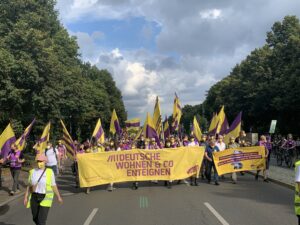
Coming from the Eastern part of Germany, I’d say that there is a connection between post-socialist countries that Westerners can hardly perceive, especially when it comes to city planning and property ownership. After the conference in Zagreb, it occurred to me that we should join forces and work on mapping capitalist building monopolies, like Strabag, in order to get a better practical grasp of the accumulation process. This could include different actors that are driving the housing crisis, such as renting firms or hotel companies. If we do our research properly, we can target them effectively – in 2021 over a million Berliners passed a referendum urging their city government to take direct action against corporate control of housing, so we are now demanding a law to expropriate highly speculative rental companies like Deutsche Wohnen.
It is also important to think about property ownership – who is buying out the land in Croatia and other parts of the Balkan region? What has been driving me as a politician in Parliament for the last ten years is the principle of following the money. There is a lot of potential for these kinds of collaborations.
How does the new European Affordable Housing Plan corroborate, or undermine, the prospects of addressing the housing crisis on an inter-European level?
The housing plan isn’t specific enough, and will come with new deregulations in the building sector. As I’ve mentioned, it is necessary to reregulate the rents and discuss affordable housing, but we also have to think about the building sector and urban planning. Conservatives would say that the solution to the housing crisis is to simply build new houses; however, new houses would do nothing to alleviate the crisis. On the contrary, with the prospect of further deregulation and the inevitable growth of big monopolies, new accommodations would be even more expensive, leading to higher rents and the collapse of social infrastructure – as we know, big developers never build social infrastructure. The industry is also expanding into areas under environmental protection, which we see all over Europe. Therefore, the plan probably won’t do much in terms of actually overcoming the crisis.
The housing crisis is intensifying in a time of unprecedented military expenditures. How do the two intersect?
The Bundeswehr is now one of the highest-funded militaries in the world, and part of its budget comes from resources granted to the Parliament for investing in public infrastructure. That means that civil infrastructure, i.e., hospitals, bridges and streets, will become more and more subordinated to the needs of the army. Another thing comes to mind as well. After the Second World War, American, British, French and Russian forces built a number of massive military facilities all over Germany. They were abandoned after the Wall fell and many of them still haven’t been repurposed for civil use. City councils started funding their transformation for social purposes, mainly affordable housing. At the end of last year, the German Ministry of Defence halted the process, imposing an indefinite moratorium on approximately 200 of these sites. Although local governments spent a great deal of money and time to utilize the places for people’s housing needs, the state saw no issue with expropriation for military purposes.
Militarization also plays a big role in construction politics. Recent changes to the German Construction Law will allow new military hotspots to be built without official permits, and especially without the participation of the people.
Unfortunately, the discourse around sustainable, inclusive, humane ways of democratizing the economy is constantly being hijacked by far-right scapegoating, to which people are increasingly turning in these times of political and economic instability. How can we counter that?
After World War II, there was a consensus in Germany about the need to rebuild the cities through democratic structures, together with the people. The project was deeply connected to modernist urbanism of the 1920s, with its democratic architecture, residential estates surrounded by green spaces, integrated transport, etc. Contemporary elites have more or less forgotten this heritage, because modern city planning as a democratic right has been destroyed. Cities cannot be investors’ laboratories; we need radical democracy in spatial planning. That is one of the ways we can counter the far-right constantly weaponizing these class concerns.
Instead of empowering the people to participate, the state endorses gentrification, backing rich people entering city centres to make them more attractive, while pushing others to the periphery. That also contributes to social tensions. Fighting against this kind of segregation is vital in introducing democracy into our physical spaces.
Last year you voted to allow a second ballot in the federal elections after Friedrich Merz failed to secure a majority in Parliament, ultimately leading to his re-election as Chancellor. What was the reasoning behind that, apart from minimizing the power of the far-right?
The Chancellor election was essentially a technical thing. It makes no sense to gamble in these situations if you don’t have a clear plan of what to do, especially with the political shift toward the far-right. The federal elections were really a loss for the conservatives, because they didn’t make it in the first round. We didn’t vote for Merz specifically, we just voted to allow a re-election, thinking: okay, you’re a loser, try to go again.
Like a lot of my colleagues, I do the political work in my own electoral district, together with the people. I organize demonstrations, hold meetings in the neighbourhoods and work very closely with my fellow citizens to evolve my political ideas and bring them into the Parliament. It’s a very grassroots approach. If you go into the Parliament with the very radical idea of just being honest, it is bound to get messy. The question is also how to report what happens in the Parliament back to the community, since we are very limited in our resources and communication platforms. Still, that drives us to connect more closely to people at the base. That’s the way I work and I think it is the right way to work.
The Left has been gaining a lot of traction with young people. What contributed to this electoral shift?
Many factors. We reorganized our party in the last five years, especially in the wake of conservatives shifting to the right. Then, our young Bundestag leader, Heidi Reichinnek, delivered a speech during the 2025 Budget Debate which soon went viral, extending our social media reach, though our politics haven’t changed. What we are demanding is what we have always demanded. It’s just a question of communication. However, if we can only reach young people through TikTok, that is a serious problem. It’s undemocratic to depend on the algorithms of big tech companies for engagement, because it reduces complex debates in a way that erodes discourse around the huge crises we are faced with today.
Lastly, what would a democratic, anticapitalist city look like?
I’m a big fan of socialist modernism, though I am also critical of its zoning principle, i.e., separating cities into mono-functional areas for work, recreation, sleep, etc. Our postmodern reality has overcome the need for such divisions. For example, young people want to live in lively neighbourhoods where they can go out and socialize. Enter the 15-minute city, a planning model developed in opposition to zoning, where residents can access essential services, like healthcare, education, work and groceries, within a 15-minute walk from their homes. Although the idea is to have a decentralized network of good medical infrastructure, good culture centres, schools and kindergartens, contemporary discussions of the 15-minute city are mostly held in a capitalist environment.
It becomes an attraction for inner-city districts and subsequently pushes out lower-income residents, which fuels class struggle in cities that are already deeply divided. And then you get exclusive urban bubbles and their underdeveloped counterparts on the periphery. People are kicked out not only from these spaces, but also from the discussion around them. When we talk about Berlin, four decades of gentrification and segregation have transformed the inner-city circle into a place more akin to a museum, particularly due to tourism. Postcapitalist cities have to be synced from the outside. 15-minute cities are also very feminist; they create the possibility of socializing reproductive and care labour, allowing kids to go to school on their own and strengthening communal spaces. Yes, the 15-minute city is a social city and a caring city, a feminist city.
